Privacy Policy
Privacy Policy
Privacy Policy Introduction and Overview
We have written this privacy policy (version 29.09.2025-312941449) in order to explain to you, in accordance with the provisions of the General Data Protection Regulation (EU) 2016/679 and applicable national laws, which personal data (data for short) we as the controller – and the processors commissioned by us (e.g. providers) – process, will process in the future and what legal options you have. The terms used are to be considered gender-neutral.
In short: We provide you with comprehensive information about any of your personal data we process.
Privacy policies usually sound very technical and use legal terminology. However, this privacy policy is intended to describe the most important things to you as simply and transparently as possible. So long as it aids transparency, technical terms are explained in a reader-friendly manner, links to further information are provided and graphics are used. We are thus informing in clear and simple language that we only process personal data in the context of our business activities if there is a legal basis for it. This is certainly not possible with brief, unclear and legal-technical statements, as is often standard on the internet when it comes to data protection. I hope you find the following explanations interesting and informative. Maybe you will also find some information that you have not been familiar with.
If you still have questions, we kindly ask you to contact the responsible body named below or in the imprint, follow the existing links and look at further information on third-party sites. You can of course also find our contact details in the imprint.
Scope
This privacy policy applies to all personal data processed by our company and to all personal data processed by companies commissioned by us (processors). With the term personal data, we refer to information within the meaning of Article 4 No. 1 GDPR, such as the name, email address and postal address of a person. The processing of personal data ensures that we can offer and invoice our services and products, be it online or offline. The scope of this privacy policy includes:
- all online presences (websites, online shops) that we operate
- Social media presences and email communication
- mobile apps for smartphones and other devices
In short: This privacy policy applies to all areas in which personal data is processed in a structured manner by the company via the channels mentioned. Should we enter into legal relations with you outside of these channels, we will inform you separately if necessary.
Legal bases
In the following privacy policy, we provide you with transparent information on the legal principles and regulations, i.e. the legal bases of the General Data Protection Regulation, which enable us to process personal data.
Whenever EU law is concerned, we refer to REGULATION (EU) 2016/679 OF THE EUROPEAN PARLIAMENT AND OF THE COUNCIL of April 27, 2016. You can of course access the General Data Protection Regulation of the EU online at EUR-Lex, the gateway to EU law, at https://eur-lex.europa.eu/legal-content/EN/TXT/?uri=celex%3A32016R0679.
We only process your data if at least one of the following conditions applies:
- Consent (Article 6 Paragraph 1 lit. a GDPR): You have given us your consent to process data for a specific purpose. An example would be the storage of data you entered into a contact form.
- Contract (Article 6 Paragraph 1 lit. b GDPR): We process your data in order to fulfill a contract or pre-contractual obligations with you. For example, if we conclude a sales contract with you, we need personal information in advance.
- Legal obligation (Article 6 Paragraph 1 lit. c GDPR): If we are subject to a legal obligation, we will process your data. For example, we are legally required to keep invoices for our bookkeeping. These usually contain personal data.
- Legitimate interests (Article 6 Paragraph 1 lit. f GDPR): In the case of legitimate interests that do not restrict your basic rights, we reserve the right to process personal data. For example, we have to process certain data in order to be able to operate our website securely and economically. Therefore, the processing is a legitimate interest.
Other conditions such as making recordings in the interest of the public, the exercise of official authority as well as the protection of vital interests do not usually occur with us. Should such a legal basis be relevant, it will be disclosed in the appropriate place.
In addition to the EU regulation, national laws also apply:
- In Austria this is the Austrian Data Protection Act (Datenschutzgesetz), in short DSG.
- In Germany this is the Federal Data Protection Act (Bundesdatenschutzgesetz), in short BDSG.
Should other regional or national laws apply, we will inform you about them in the following sections.
Contact details of the data protection controller
If you have any questions about data protection or the processing of personal data, you will find below the contact details of the controller in accordance with Article 4(7) of the EU General Data Protection Regulation (GDPR):
corosys technologies GmbH
Hessenstrasse 23
D-65719 Hofheim am Taunus
Deutschland
E-Mail: datenschutz@corosys.com
Phone: +49 6122 / 7075-0
Company details: https://www.corosys.com/en/imprint.php
Storage Period
It is a general criterion for us to store personal data only for as long as is absolutely necessary for the provision of our services and products. This means that we delete personal data as soon as any reason for the data processing no longer exists. In some cases, we are legally obliged to keep certain data stored even after the original purpose no longer exists, such as for accounting purposes.
If you want your data to be deleted or if you want to revoke your consent to data processing, the data will be deleted as soon as possible, provided there is no obligation to continue its storage.
We will inform you below about the specific duration of the respective data processing, provided we have further information.
Rights in accordance with the General Data Protection Regulation
In accordance with Articles 13, 14 of the GDPR, we inform you about the following rights you have to ensure fair and transparent processing of data:
- According to Article 15 DSGVO, you have the right to information about whether we are processing data about you. If this is the case, you have the right to receive a copy of the data and to know the following information:
- for what purpose we are processing;
- the categories, i.e. the types of data that are processed;
- who receives this data and if the data is transferred to third countries, how security can be guaranteed;
- how long the data will be stored;
- the existence of the right to rectification, erasure or restriction of processing and the right to object to processing;
- that you can lodge a complaint with a supervisory authority (links to these authorities can be found below);
- the origin of the data if we have not collected it from you;
- Whether profiling is carried out, i.e. whether data is automatically evaluated to arrive at a personal profile of you.
- You have a right to rectification of data according to Article 16 GDPR, which means that we must correct data if you find errors.
- You have the right to erasure (“right to be forgotten”) according to Article 17 GDPR, which specifically means that you may request the deletion of your data.
- According to Article 18 of the GDPR, you have the right to restriction of processing, which means that we may only store the data but not use it further.
- According to Article 20 of the GDPR, you have the right to data portability, which means that we will provide you with your data in a standard format upon request.
- According to Article 21 DSGVO, you have the right to object, which entails a change in processing after enforcement.
- If the processing of your data is based on Article 6(1)(e) (public interest, exercise of official authority) or Article 6(1)(f) (legitimate interest), you may object to the processing. We will then check as soon as possible whether we can legally comply with this objection.
- If data is used to conduct direct advertising, you may object to this type of data processing at any time. We may then no longer use your data for direct marketing.
- If data is used to conduct profiling, you may object to this type of data processing at any time. We may no longer use your data for profiling thereafter.
- According to Article 22 of the GDPR, you may have the right not to be subject to a decision based solely on automated processing (for example, profiling).
- You have the right to lodge a complaint under Article 77 of the GDPR. This means that you can complain to the data protection authority at any time if you believe that the data processing of personal data violates the GDPR.
In short: you have rights – do not hesitate to contact the responsible party listed above with us!
If you believe that the processing of your data violates data protection law or your data protection rights have been violated in any other way, you can complain to the supervisory authority. For Austria, this is the data protection authority, whose website can be found at https://www.dsb.gv.at/. In Germany, there is a data protection officer for each federal state. For more information, you can contact the Federal Commissioner for Data Protection and Freedom of Information (BfDI). The following local data protection authority is responsible for our company:
Web hosting
Web hosting Overview
- Affected parties: visitors to the website
- Purpose: professional hosting of the website and security of operations
- Processed data: IP address, time of website visit, browser used and other data. You can find more details on this below or at the respective web hosting provider.
- Storage period: dependent on the respective provider, but usually 2 weeks
- Legal basis: Art. 6 para. 1 lit. f GDPR (legitimate interests) |
What is web hosting?
Every time you visit a website nowadays, certain information – including personal data – is automatically created and stored, including on this website. This data should be processed as sparingly as possible, and only with good reason. By website, we mean the entirety of all websites on your domain, i.e. everything from the homepage to the very last subpage (like this one here). By domain we mean example.uk or examplepage.com.
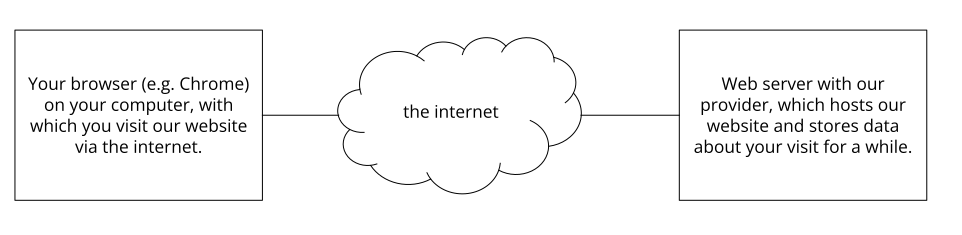
When you want to view a website on a screen, you use a program called a web browser. You probably know the names of some web browsers: Google Chrome, Microsoft Edge, Mozilla Firefox, and Apple Safari.
The web browser has to connect to another computer which stores the website’s code: the web server. Operating a web server is complicated and time-consuming, which is why this is usually done by professional providers. They offer web hosting and thus ensure the reliable and flawless storage of website data.
Whenever the browser on your computer establishes a connection (desktop, laptop, smartphone) and whenever data is being transferred to and from the web server, personal data may be processed. After all, your computer stores data, and the web server also has to retain the data for a period of time in order to ensure it can operate properly.
Illustration:
Why do we process personal data?
The purposes of data processing are:
- Professional hosting of the website and operational security
- To maintain the operational as well as IT security
- Anonymous evaluation of access patterns to improve our offer, and if necessary, for prosecution or the pursuit of claims.li>
Which data are processed?
Even while you are visiting our website, our web server, that is the computer on which this website is saved, usually automatically saves data such as
- the full address (URL) of the accessed website (e. g. https://www.examplepage.uk/examplesubpage.html?tid=312941449)
- browser and browser version (e.g. Chrome 87)
- the operating system used (e.g. Windows 10)
- the address (URL) of the previously visited page (referrer URL) (e. g. https://www.examplepage.uk/icamefromhere.html/)
- the host name and the IP address of the device from the website is being accessed from (e.g. COMPUTERNAME and 194.23.43.121)
- date and time
- in so-called web server log files
How long is the data stored?
Generally, the data mentioned above are stored for two weeks and are then automatically deleted. We do not pass these data on to others, but we cannot rule out the possibility that this data may be viewed by the authorities in the event of illegal conduct.
In short: Your visit is logged by our provider (company that runs our website on special computers (servers)), but we do not pass on your data without your consent!
Legal basis
The lawfulness of processing personal data in the context of web hosting is justified in Art. 6 para. 1 lit. f GDPR (safeguarding of legitimate interests), as the use of professional hosting with a provider is necessary to present the company in a safe and user-friendly manner on the internet, as well as to have the ability to track any attacks and claims, if necessary.
Webhosting Other
Contact data for our Webhosting:
%dp__kontaktdaten-sonstiges_webhosting-en%
You can learn more about the data processing at this provider in their Privacy Policy.
Web Analytics
Web Analytics Privacy Policy Overview
- Affected parties: visitors to the website
- Purpose: Evaluation of visitor information to optimise the website.
- Processed data: Access statistics that contain data such as access location, device data, access duration and time, navigation behaviour, click behaviour and IP addresses. You can find more details on this from the respective web analytics tool directly.
- Storage period: depending on the respective web analytics tool used
- Legal basis: Art. 6 para. 1 lit. a GDPR (consent), Art. 6 para. 1 lit. f GDPR (legitimate interests) |
What is Web Analytics?
We use software on our website, which is known as web analytics, in order to evaluate website visitor behaviour. Thus, data is collected, which the analytic tool provider (also called tracking tool) stores, manages and processes. Analyses of user behaviour on our website are created with this data, which we as the website operator receive. Most tools also offer various testing options. These enable us, to for example test which offers or content our visitors prefer. For this, we may show you two different offers for a limited period of time. After the test (a so-called A/B test) we know which product or content our website visitors find more interesting. For such testing as well as for various other analyses, user profiles are created and the respective data is stored in cookies.
Why do we run Web Analytics?
We have a clear goal in mind when it comes to our website: we want to offer our industry’s best website on the market. Therefore, we want to give you both, the best and most interesting offer as well as comfort when you visit our website. With web analysis tools, we can observe the behaviour of our website visitors, and then improve our website accordingly for you and for us. For example, we can see the average age of our visitors, where they come from, the times our website gets visited the most, and which content or products are particularly popular. All this information helps us to optimise our website and adapt it to your needs, interests and wishes.
Which data are processed?
The exact data that is stored depends on the analysis tools that are being used. But generally, data such as the content you view on our website are stored, as well as e. g. which buttons or links you click, when you open a page, which browser you use, which device (PC, tablet, smartphone, etc.) you visit the website with, or which computer system you use. If you have agreed that location data may also be collected, this data may also be processed by the provider of the web analysis tool.
Moreover, your IP address is also stored. According to the General Data Protection Regulation (GDPR), IP addresses are personal data. However, your IP address is usually stored in a pseudonymised form (i.e. in an unrecognisable and abbreviated form). No directly linkable data such as your name, age, address or email address are stored for testing purposes, web analyses and web optimisations. If this data is collected, it is retained in a pseudonymised form. Therefore, it cannot be used to identify you as a person.
The following example shows Google Analytics’ functionality as an example for client-based web tracking with JavaScript code.
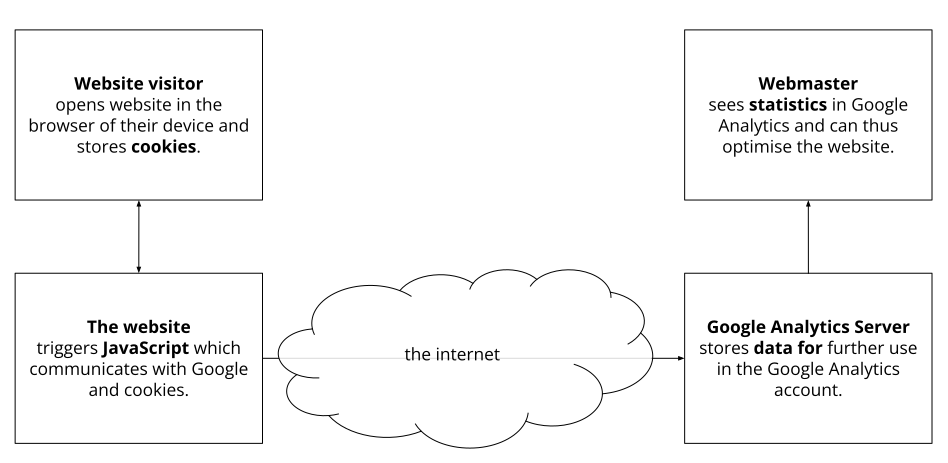
The storage period of the respective data always depends on the provider. Some cookies only retain data for a few minutes or until you leave the website, while other cookies can store data for several years.
Duration of data processing
If we have any further information on the duration of data processing, you will find it below. We generally only process personal data for as long as is absolutely necessary to provide products and services. The storage period may be extended if it is required by law, such as for accounting purposes for example for accounting.
Right to object
You also have the option and the right to revoke your consent to the use of cookies or third-party providers at any time. This works either via our cookie management tool or via other opt-out functions. For example, you can also prevent data processing by cookies by managing, deactivating or erasing cookies in your browser.
Legal basis
The use of Web Analytics requires your consent, which we obtained with our cookie popup. According to Art. 6 para. 1 lit. a of the GDPR (consent), this consent represents the legal basis for the processing of personal data, such as by collection through Web Analytics tools.
In addition to consent, we have a legitimate interest in analysing the behaviour of website visitors, which enables us to technically and economically improve our offer. With Web Analytics, we can recognise website errors, identify attacks and improve profitability. The legal basis for this is Art. 6 para. 1 lit. f of the GDPR (legitimate interests). Nevertheless, we only use these tools if you have given your consent.
Since Web Analytics tools use cookies, we recommend you to read our privacy policy on cookies. If you want to find out which of your data are stored and processed, you should read the privacy policies of the respective tools.
If available, information on special Web Analytics tools can be found in the following sections.
Google Analytics Privacy Policy
Google Analytics Privacy Policy Overview
- Affected parties: website visitors
- Purpose: Evaluation of visitor information to optimise the website.
- Processed data: Access statistics that contain data such as the location of access, device data, access duration and time, navigation behaviour and click behaviour. You can find more details on this in the privacy policy below.
- Storage period: Customizable, GA4 stores data for 14 months by default.
- Legal basis: Art. 6 para. 1 lit. a GDPR (consent), Art. 6 para. 1 lit. f GDPR (legitimate interests) |
What is Google Analytics?
On our website, we use the analytics tracking tool Google Analytics in the Google Analytics 4 (GA4) version provided by the American company Google Inc. For the European region, Google Ireland Limited (Gordon House, Barrow Street Dublin 4, Ireland) is responsible for all Google services. Google Analytics collects data about your actions on our website. By combining various technologies such as cookies, device IDs, and login information, you can be identified as a user across different devices. This allows your actions to be analyzed across platforms as well.
For example, when you click on a link, this event is stored in a cookie and sent to Google Analytics. With the reports we receive from Google Analytics, we can better tailor our website and service to your needs. In the following, we will provide more information about the tracking tool and specifically inform you about the data processed and how you can prevent it.
Google Analytics is a tracking tool used for website traffic analysis. The basis for these measurements and analyses is a pseudonymous user identification number. This number does not include personally identifiable information such as name or address but is used to assign events to a device. GA4 utilizes an event-based model that captures detailed information about user interactions such as page views, clicks, scrolling, and conversion events. Additionally, GA4 incorporates various machine learning features to better understand user behavior and certain trends. GA4 employs modeling through machine learning capabilities, meaning that based on the collected data, missing data can be extrapolated to optimize the analysis and provide forecasts.
In order for Google Analytics to function properly, a tracking code is embedded in the code of our website. When you visit our website, this code records various events that you perform on our website. With GA4’s event-based data model, we, as website operators, can define and track specific events to obtain analyses of user interactions. This allows us to track not only general information such as clicks or page views but also specific events that are important for our business, such as submitting a contact form or making a purchase.
Once you leave our website, this data is sent to and stored on Google Analytics servers.
Google processes the data, and we receive reports on your user behavior. These reports can include, among others, the following:
- Audience reports: Audience reports help us get to know our users better and gain a more precise understanding of who is interested in our service.
- Advertising reports: Advertising reports make it easier for us to analyze and improve our online advertising.
- Acquisition reports: Acquisition reports provide helpful information on how we can attract more people to our service.
- Behavior reports: Here, we learn about how you interact with our website. We can track the path you take on our site and which links you click on.
- Conversion reports: Conversion refers to an action you take as a result of a marketing message, such as going from being a website visitor to becoming a buyer or newsletter subscriber. Through these reports, we gain insights into how our marketing efforts resonate with you, with the aim of improving our conversion rate.
- Real-time reports: With real-time reports, we can see what is currently happening on our website. For example, we can see how many users are currently reading this text.
In addition to the above-mentioned analysis reports, Google Analytics 4 also offers the following functions:
- Event-based data model: This model captures specific events that can occur on our website, such as playing a video, making a purchase, or subscribing to our newsletter.
- Advanced analytics features: With these features, we can gain a better understanding of your behavior on our website or certain general trends. For example, we can segment user groups, conduct comparative analyses of target audiences, or track your path on our website.
- Predictive modeling: Based on the collected data, missing data can be extrapolated through machine learning to predict future events and trends. This can help us develop better marketing strategies.
- Cross-platform analysis: Data collection and analysis are possible from both websites and apps. This enables us to analyze user behavior across platforms, provided you have consented to data processing.
Why do we use Google Analytics on our website?
Our goal with this website is clear: we want to provide you with the best possible service. The statistics and data from Google Analytics help us achieve this goal.
The statistically evaluated data gives us a clear picture of the strengths and weaknesses of our website. On one hand, we can optimize our site to make it more easily found by interested people on Google. On the other hand, the data helps us better understand you as a visitor. We know exactly what we need to improve on our website in order to provide you with the best possible service. The data also helps us conduct our advertising and marketing activities in a more personalized and cost-effective manner. After all, it only makes sense to show our products and services to people who are interested in them.
What data is stored by Google Analytics?
With the help of a tracking code, Google Analytics creates a random, unique ID associated with your browser cookie. This way, Google Analytics recognizes you as a new user, and a user ID is assigned to you. When you visit our site again, you are recognized as a “returning” user. All collected data is stored together with this user ID, making it possible to evaluate pseudonymous user profiles.
To analyze our website with Google Analytics, a property ID must be inserted into the tracking code. The data is then stored in the corresponding property. For each newly created property, the default is Google Analytics 4 Property. The data storage duration varies depending on the property used.
Through identifiers such as cookies, app instance IDs, user IDs, or custom event parameters, your interactions, if you have consented, are measured across platforms. Interactions encompass all types of actions you perform on our website. If you also use other Google systems (such as a Google account), data generated through Google Analytics can be linked to third-party cookies. Google does not disclose Google Analytics data unless we, as website operators, authorize it, except when required by law.
According to Google, IP addresses are not logged or stored in Google Analytics 4. However, IP address data is used by Google for deriving location data and is immediately deleted thereafter. All IP addresses collected from users in the EU are deleted before the data is stored in a data center or on a server.
Since GA4 focuses on event-based data, the tool uses significantly fewer cookies compared to previous versions such as Google Universal Analytics. However, there are still some specific cookies used by GA4. These can include:
Name: _ga
Value: 2.1326744211.152312941449-5
Purpose: By default, analytics.js uses the _ga cookie to store the user ID. It is used to distinguish website visitors.
Expiration: After 2 years
Name: _gid
Value: 2.1687193234.152312941449-1
Purpose: This cookie is also used to distinguish website visitors.
Expiration: After 24 hours
Name: gat_gtag_UA Value: 1
Purpose: Used to reduce the request rate. If Google Analytics is deployed via Google Tag Manager, this cookie will be named dc_gtm .
Expiration: After 1 minute
Note: This list cannot claim to be exhaustive, as Google may change their choice of cookies from time to time. GA4 aims to improve data privacy and offers several options for controlling data collection. For example, we can determine the storage duration ourselves and control data.
Here we provide an overview of the main types of data collected by Google Analytics:
Heatmaps: Google creates heatmaps to show the exact areas you click on. This provides us with information about your interactions on our site.
Session Duration: Google refers to session duration as the time you spend on our site without leaving. If you are inactive for 20 minutes, the session automatically ends.
Bounce Rate: Bounce rate refers to when you view only one page on our website and then leave.
Account Creation: If you create an account or place an order on our website, Google Analytics collects this data.
Location: IP addresses are not logged or stored in Google Analytics. However, location data is derived shortly before the IP address is deleted.
Technical Information: Technical information includes your browser type, internet service provider, and screen resolution, among others.
Source of Origin: Google Analytics is interested in the website or advertisement that brought you to our site.
Additional data may include contact information, reviews, media playback (e.g., if you play a video on our site), sharing of content via social media, or adding to favorites. This list is not exhaustive and serves only as a general guide to the data storage by Google Analytics.
Where and how long are the data stored?
Google has servers distributed worldwide. You can find precise information about the locations of Google data centers at: https://datacenters.google/
Your data is distributed across multiple physical storage devices. This ensures faster access to data and better protection against manipulation. Each Google data center has emergency programs in place for your data. In the event of hardware failure or natural disasters, the risk of service interruption at Google remains low.
The retention period of data depends on the properties used. The storage duration is always set separately for each individual property. Google Analytics offers us four options for controlling the storage duration:
- 2 months: This is the shortest storage period.
- 14 months: By default, data is stored in GA4 for 14 months.
- 26 months: Data can also be stored for 26 months.
- Data is only deleted manually.
In addition, there is also the option for data to be deleted only if you do not visit our website within the selected time period. In this case, the retention period is reset every time you revisit our website within the defined time frame.
Once the defined period has expired, the data is deleted once a month. This retention period applies to data linked to cookies, user identification, and advertising IDs (e.g., cookies from the DoubleClick domain). Report results are based on aggregated data and are stored independently of user data. Aggregated data is a combination of individual data into larger units.
How can I delete my data or prevent data storage?
Under the data protection laws of the European Union, you have the right to access, update, delete, or restrict your data. By using the browser add-on to deactivate Google Analytics JavaScript (analytics.js, gtag.js), you can prevent Google Analytics 4 from using your data. You can download and install the browser add-on at: https://tools.google.com/dlpage/gaoptout?hl=en Please note that this add-on only disables data collection by Google Analytics.
If you want to disable, delete, or manage cookies in general, you can find the respective instructions for the most common browsers in the “Cookies” section.
Legal basis
The use of Google Analytics requires your consent, which we obtained through our cookie popup. According to Art. 6(1)(a) of the GDPR, this consent constitutes the legal basis for the processing of personal data that may occur during the collection by web analytics tools.
In addition to consent, we also have a legitimate interest in analyzing the behavior of website visitors to improve our offering technically and economically. By using Google Analytics, we can identify website errors, detect attacks, and improve efficiency. The legal basis for this is Art. 6(1)(f) of the GDPR (legitimate interests). However, we only use Google Analytics if you have given your consent.
Google processes data from you, among other things, in the USA. Google is an active participant in the EU-US Data Privacy Framework, which regulates the correct and secure transfer of personal data from EU citizens to the USA. More information can be found at https://commission.europa.eu/document/fa09cbad-dd7d-4684-ae60-be03fcb0fddf_en.
Additionally, Google uses so-called Standard Contractual Clauses (Article 46(2) and (3) GDPR). Standard Contractual Clauses (SCC) are template clauses provided by the EU Commission and are designed to ensure that your data complies with European data protection standards, even when transferred and stored in third countries (such as the USA). Through the EU-US Data Privacy Framework and the Standard Contractual Clauses, Google commits to maintaining the European data protection level when processing your relevant data, even if the data is stored, processed, and managed in the USA. These clauses are based on an implementing decision of the EU Commission. You can find the decision and the corresponding Standard Contractual Clauses here: https://ec.europa.eu/commission/presscorner/detail/en/ip_21_2847.
You can find the Google Ads Data Processing Terms, which refer to the Standard Contractual Clauses, at: https://business.safety.google/intl/en/adsprocessorterms/
We hope we have provided you with the most important information regarding the data processing by Google Analytics. If you want to learn more about the tracking service, we recommend the following links: https://marketingplatform.google.com/about/analytics/terms/en/ and https://support.google.com/analytics/answer/6004245?hl=en
If you want to learn more about data processing, you can refer to the Google Privacy Policy at: https://policies.google.com/privacy?hl=en.
Matomo On-Premise Privacy Policy
Matomo On-Premise Privacy Policy Overview
- Affected parties: website visitors
- Purpose: Evaluation of visitor information to optimise the website.
- Processed data: Data such as the number of website visitors, page views, duration of visits, or used search terms. More details can be found below and in the privacy policy of Matomo On-Premise.
- Storage period: In principle, the data is stored with us for as long as business purposes require.
- Legal bases: Art. 6 para. 1 lit. a GDPR (consent), Art. 6 para. 1 lit. f GDPR (legitimate interests) |
What is Matomo On-Premise?
We use the privacy-friendly analytics program Matomo On-Premise on our website. In the On-Premise version, Matomo is installed on our own server. This means we act as the operator of the software, and any data we might collect from you is stored directly with us. The data processing thus remains entirely within our control. The tool is developed by the New Zealand-based company InnoCraft Ltd, 7 Waterloo Quay PO625, 6140 Wellington, New Zealand.
Matomo On-Premise is a web analytics platform that takes data privacy seriously while providing accurate statistics on your behavior on our website for us as website operators. A significant difference from other analytics programs is the option of data storage on our own server. Matomo On-Premise also offers various ways to anonymize IP addresses of our website visitors and disable cookies.
Why do we use Matomo On-Premise?
Many common analytics tools collect vast amounts of personally identifiable information and may share it with third parties. This means maintaining control over your data becomes challenging. Data privacy is a significant concern for us, and that’s why we opted for Matomo On-Premise, a considerably more privacy-friendly alternative. However, we do not want to completely forego web analytics. After all, with the help of statistics on website behavior, we can optimize our service and tailor it to your individual needs.
What data is stored by Matomo On-Premise?
In addition to personally identifiable information you actively provide, such as your IP address or personal details (e.g., name, address, date of birth), Matomo On-Premise primarily stores information about your visitor behavior. This usually involves non-personal data, such as the number of website visitors, page views, duration of visits, or used search terms. Technical data like browser type, operating system, and screen resolution can also be stored. Matomo On-Premise may collect information about the website from which you accessed ours. The collected data is stored with us and not shared or sold to third parties.
How long and where are the data stored?
Matomo On-Premise is a self-hosted analytics platform, meaning we store all collected data directly on our own servers. Our server is located in Europe, so data is not processed in third countries, i.e., countries outside the scope of the GDPR.
In general, data is stored with us for as long as business purposes require. Unfortunately, we cannot provide precise retention periods at this point, as they strongly depend on our individual configurations. If you want to learn more about our data retention periods and configurations, please feel free to contact us.
How can I delete my data or prevent data storage?
You have the right and the option to access your personally identifiable data at any time and object to its use and processing. You can also file a complaint with a state supervisory authority or with us at any time.
In your browser, you also have the option to manage, delete, or disable cookies individually. Please note that disabled or deleted cookies may have potential negative effects on the functions of our website. The process of managing cookies may vary depending on the browser you use. The respective links to the instructions for the most popular browsers can be found under the “Cookies” section. If you want to request data deletion, you can also contact us.
Legal Basis
The use of Matomo On-Premise requires your consent, which we obtained through our Consent Management Tool (Popup). According to Art. 6 (1) lit. a GDPR (Consent), this consent is the legal basis for the processing of personally identifiable data, as may occur with the collection by web analytics tools.
In addition to consent, we have a legitimate interest in analyzing the behavior of website visitors to technically and economically improve our offerings. By using Matomo On-Premise, we can identify optimization potential for our website and improve efficiency. The legal basis for this is Art. 6 (1) lit. f GDPR (Legitimate Interests). However, we only use Matomo On-Premise to the extent that you have given consent.
If you want to learn more about the data processing by Matomo On-Premise, feel free to contact us. We also recommend Matomo’s privacy policy at https://matomo.org/privacy-policy/.
Matomo On-Premise (ohne Cookies)
What is Matomo On-Premise (without Cookies)?
We use the privacy-friendly analytics program Matomo On-Premise without the use of cookies on our website. With the On-Premise version, Matomo is installed on our own server. This means we act as the operator of the software, and any potential data we could collect from you is stored directly with us. Thus, data processing remains entirely within our control. The tool is developed by the New Zealand-based company InnoCraft Ltd, 7 Waterloo Quay PO625, 6140 Wellington, New Zealand.
Matomo On-Premise is a web analytics platform that takes data protection seriously and still provides accurate statistics on your behavior on our website. A significant difference from other analytics programs is the option of storing data on our own server. Matomo On-Premise also offers various ways to anonymize IP addresses of our website visitors and disable cookies. We have also opted for cookie deactivation. This means we use Matomo On-Premise for our website without the use of cookies.
Why do we use Matomo On-Premise?
Many common analytics tools collect vast amounts of personally identifiable information and may share it with third parties, making data control challenging. Data protection is a significant concern for us, and that’s why we chose Matomo On-Premise without the use of cookies. However, we also don’t want to entirely forego web analytics. Statistics on website behavior help us optimize our service and tailor it to your individual needs.
What data does Matomo On-Premise store?
Primarily, Matomo On-Premise stores information about your visitor behavior. This is not personal data but includes information such as website visitor count, page views, duration of visits, or used search terms. Additionally, technical data such as browser type, your operating system, and screen resolution may be stored. Matomo On-Premise can also collect information about the website you came from. The collected data is stored with us and is not shared or sold to third parties.
How long and where are the data stored?
Matomo On-Premise is a self-hosted analytics platform, meaning we store all collected data directly on our own servers. Our server is located in Europe, so data is not processed in third countries, i.e., countries outside the scope of the GDPR.
In general, the data is stored with us as long as required for business purposes. Unfortunately, we cannot provide precise retention periods here as they strongly depend on our individual configurations. If you want to learn more about our data storage duration and configurations, please feel free to contact us.
How can I delete my data or prevent data storage?
You have the right and the option to access your personal data, object to its use and processing, and submit a complaint to a state supervisory authority or simply to us at any time.
Legal Basis
We have a legitimate interest in analyzing the behavior of website visitors to improve our technical and economic offerings. With the help of Matomo On-Premise, we identify optimization potential for our website and enhance cost-effectiveness. The legal basis for this is Art. 6 para. 1 lit. f GDPR (Legitimate interests).
If you want to know more about the data processing by Matomo On-Premise without cookies, feel free to contact us. We also recommend Matomo’s privacy policy at https://matomo.org/privacy-policy/.
Online Marketing
Online Marketing Privacy Policy Overview
_ Affected parties: visitors to the website
_ Purpose: Evaluation of visitor information for website optimisation
_ Processed data: Access statistics containing data such as access location, device data, access duration and time, navigation behaviour, click behaviour and IP addresses. Personal data such as name or email address may also be processed. You can find more details on this from the respective Online Marketing tool.
_ Storage period: depending on the Online Marketing tools used
⚖️ Legal basis: Art. 6 para. 1 lit. a GDPR (consent), Art. 6 para. 1 lit. f GDPR (legitimate interests) |
What is Online Marketing?
Online Marketing refers to all measures that are carried out online to achieve marketing goals, such as increasing brand awareness or doing business transactions. Furthermore, our Online Marketing measures aim to draw people’s attention to our website. In order to be able to show our offer to many interested people, we do Online Marketing. It mostly is about online advertising, content marketing or search engine optimisation. For this, personal data is also stored and processed, to enable us to use Online Marketing efficiently and targeted. On the one hand, the data help us to only show our content to people who are interested in it. On the other hand, it helps us to measure the advertising success of our Online Marketing measures.
Why do we use Online Marketing tools?
We want to show our website to everyone who is interested in our offer. We are aware that this is not possible without conscious measures being taken. That is why we do Online Marketing. There are various tools that make working on our Online Marketing measures easier for us. These also provide suggestions for improvement via data. Thus, we can target our campaigns more precisely to our target group. The ultimate purpose of these Online Marketing tools is to optimise our offer.
Which data are processed?
For our Online Marketing to work and to measure its success, user profiles are created and data are e.g. stored in cookies (small text files). With the help of this data, we can not only advertise in the traditional way, but also present our content directly on our website in the way you prefer. There are various third-party tools that offer these functions and thus collect and store your data accordingly. The aforementioned cookies e.g. store the pages you visit on our website, how long you view these pages, which links or buttons you click or which website you came from. What is more, technical information may also be stored. This may include e.g. your IP address, the browser and device you use to visit our website or the time you accessed our website as well as the time you left. If you have agreed for us to determine your location, we can also store and process it.
Your IP address is stored in pseudonymised form (i.e. shortened). What is more, distinct data that directly identify you as a person, such as your name, address or email address, are only stored in pseudonymised for advertising and Online Marketing purposes. With this data we cannot identify you as a person and only retain the pseudonymised information that is stored in your user profile.
Under certain circumstances, cookies may also be utilised, analysed and used for advertising purposes on other websites that use the same advertising tools. Thus, your data may then also be stored on the servers of the respective provider of the advertising tool.
In rare exceptions, unique data (name, email address, etc.) may also be stored in the user profiles. This can happen, if you are for example a member of a social media channel that we use for our Online Marketing measures and if the network connects previously received data with the user profile.
We only ever receive summarised information from the advertising tools we use that do store data on their servers. We never receive data that can be used to identify you as an individual. What is more, the data only shows how well-placed advertising measures have worked. For example, we can see what measures have caused you or other users to visit our website and purchase a service or product. Based on these analyses we can improve our advertising offer in the future and adapt it more precisely to the needs and wishes of people who are interested.
Duration of data processing
Below we will inform you on the duration of data processing, provided we have this information. In general, we only process personal data for as long as is absolutely necessary to provide our services and products. Data stored in cookies are retained for different lengths of time. Some cookies are deleted after you leave a website, while others may be stored in your browser for a number of years. However, in the respective privacy policies of the respective provider, you will usually find detailed information on the individual cookies this provider uses.
Right of withdrawal
You also retain the right and the option to revoke your consent to the use of cookies or third-party providers at any time. This can be done either via our cookie management tool or via other opt-out functions. You can for example also prevent data collection by cookies if you manage, deactivate or erase cookies in your browser. The legality of the processing remains unaffected to the point of revocation.
Since Online Marketing tools usually use cookies, we also recommend you to read our privacy policy on cookies. If you want to find out which of your data is stored and processed, you should read the privacy policies of the respective tools.
Legal basis
If you have consented to the use of third-party providers, then this consent is the legal basis for the corresponding data processing. According to Art. 6 para. 1 lit. a GDPR (consent) , this consent is the legal basis for personal data processing, as may be done when data is collected by online marketing tools.
Moreover, we have a legitimate interest in measuring our online marketing activities in anonymised form, in order to use this data for optimising our offer and our Marketing. The corresponding legal basis for this is Art. 6 para. 1 lit. f GDPR (legitimate interests) . Nevertheless, we only use these tools if you have given your consent.
Information on special online marketing tools can be found in the following sections, provided this information is available.
Google Ads (Google AdWords) Conversion Tracking Privacy Policy
Google Ads (Google AdWords) Conversion Tracking Privacy Policy Overview
- Affected parties: visitors to the website
- Purpose: economic success and service optimisation.
- Processed data: Access statistics that contain data such as access location, device data, access duration and time, navigation behaviour, click behaviour and IP addresses. Personal data such as name or email address may also be processed.
- Storage period: Conversion cookies usually expire after 30 days and do not transmit any personal data
- Legal bases: Art. 6 para. 1 lit. a GDPR (consent), Art. 6 para. 1 lit.f GDPR (legitimate interests) |
What is Google Ads conversion tracking?
We use Google Ads (previously Google AdWords) as an online marketing measure, to advertise our products and services. Thus, we want to draw more people’s attention on the internet to the high quality of our offers. As part of our advertising measures with Google Ads, we use the conversion tracking of Google LLC., 1600 Amphitheatre Parkway, Mountain View, CA 94043, USA (“Google”) on our website. With the aid of this free tracking tool we can tailor our advertising offer better to your interests and needs. In the following article we will explain, why we use conversion tracking, what data gets saved and how you can prevent this data retention.
Google Ads (previously Google AdWords) is the internal online advertising sxstem of the company Google LLC. We are convinced of our offer‘s quality and would like as many people as possible to discover our website. For this, Google Ads offers the best platform within the online environment. Of course, we also want to get an overview of the cost-benefit factor of our advertising campaigns. Thence, we use Google Ads’ conversion tracking tool.
But what is a conversion actually? A conversion occurs, when you turn from an interested visitor into an acting website visitor. This happens every time you click on our ad and then make another action, such as paying a visit to our website. With Google’s conversion tracking tool, we can understand what happens after a user clicks our Google ad. It shows us for instance if products get bought, services are used or whether users have subscribed to our newsletter.
Why do we use Google Ads conversion tracking on our website?
We use Google Ads to show our offer also across other websites. Our aim is for our advertising campaigns to reach only those people, who are interested in our offers. With the conversion tracking tool, we see what keywords, ads, ad groups and campaigns lead to the desired customer actions. We see how many customers interact with our ads on a device, to then convert. With this data we can calculate our cost-benefit-factor, measure the success of individual ad campaigns and therefore optimise our online marketing measures. With the help of the obtained data we can give our website a more interesting design and customise our advertising offer better to your needs.
What data is stored with Google Ads conversion tracking?
For a better analysis of certain user actions, we have integrated a conversion tracking tag, or code snippet to our website. Therefore, if you click one of our Google ads, a Google domain stores the cookie “conversion” on your computer (usually in the browser) or on your mobile device. Cookies are little text files that save information on your computer.
Here are data of the most significant cookies for Google’s conversion tracking:
Name: Conversion
Value: EhMI_aySuoyv4gIVled3Ch0llweVGAEgt-mr6aXd7dYlSAGQ312941449-3
Purpose: This cookie saves every conversion you make on our website after you came to us via a Google ad.
Expiry date: after 3 months
Name: _gac
Value: 1.1558695989.EAIaIQobChMIiOmEgYO04gIVj5AYCh2CBAPrEAAYASAAEgIYQfD_BwE
Purpose: This is a classic Google Analytics Cookie that records various actions on our website.
Expiry date: after 3 months
Note: The cookie _gac only appears in connection with Google Analytics. The above list does not claim to be exhaustive, as Google repeatedly change the cookies they use for analytical evaluation.
As soon as you complete an action on our website, Google identifies the cookie and saves your action as a so-called conversion. For as long as you surf our website, provided the cookie has not expired, both Google and us can determine that you found your way to us via a Google ad. Then, the cookie is read and sent back to Google Ads, together with the conversion data. Moreover, other cookies may also be used for measuring conversions. Google Ads‘ conversion tracking can be fine-tuned and improved with the aid of Google Analytics. Furthermore, ads which Google displays in various places across the web, might be placed under our domain with the name “__gads” or “_gac”.
Since September 2017, analytics.js retains various campaign information with the _gac cookie. This cookie stores data, as soon as you open one of our sites that has been set up for Google Ads’ auto-tagging. In contrast to cookies that are placed for Google domains, Google can only read these conversion cookies when you are on our website. We do neither collect nor receive any personal data. We do obtain a report with statistical evaluations by Google. With the help thereof, we can not only see the total number of users who clicked our ad, but also what advertising measures were well received.
How long and where is the data stored?
At this point we want to reiterate, that we have no influence on how Google use the collected data. According to Google, the data are encrypted and stored on a secure server. In most cases, conversion cookies expire after 30 days, and do not transmit any personalised data. The cookies named “conversion“ and “_gac“ (which is used with Google Analytics) have an expiry date of 3 months.
How can I erase my data or prevent data retention?
You have the possibility to opt out of Google Ads’ conversion tracking. The conversion tracking can be blocked by deactivating the conversion tracking cookie via your browser. If you do this, you will not be considered for the statistic of the tracking tool. You can change the cookie settings in your browser anytime. Doing so, works a little different in every browser. Hence, in the following you will find an instruction on how to manage cookies in your browser:
Chrome: Clear, enable and manage cookies in Chrome
Safari: Manage cookies and website data in Safari
Firefox: Clear cookies and site data in Firefox
Internet Explorer: Delete and manage cookies
Microsoft Edge: Delete cookies in Microsoft Edge
If you generally do not want to allow any cookies at all, you can set up your browser to notify you whenever a potential cookie is about to be set. This lets you decide upon permitting or denying the cookie’s placement. By downloading and installing the browser plugin at https://support.google.com/ads/answer/7395996 you can also deactivate all “advertising cookies”. Please consider that by deactivating these cookies, you cannot prevent all advertisements, only personalised ads.
Legal basis
If you have consented to the use of Google Ads Conversion Tracking, your consent is the legal basis for the corresponding data processing. According to Art. 6 para. 1 lit. a GDPR (consent), this consent is the legal basis for personal data processing, as may be done when collected by Google Ads Conversion Tracking.
We also have legitimate interest in using Google Ads Conversion Tracking to optimise our online service and marketing measures. The corresponding legal basis for this is Art. 6 para. 1 lit. f GDPR (legitimate interests). Nevertheless, we only use Google Ads Conversion Tracking if you have consented to it.
Google processes data from you, among other things, in the USA. Google is an active participant in the EU-US Data Privacy Framework, which regulates the correct and secure transfer of personal data from EU citizens to the USA. More information can be found at https://commission.europa.eu/document/fa09cbad-dd7d-4684-ae60-be03fcb0fddf_en.
Additionally, Google uses so-called Standard Contractual Clauses (Article 46(2) and (3) GDPR). Standard Contractual Clauses (SCC) are template clauses provided by the EU Commission and are designed to ensure that your data complies with European data protection standards, even when transferred and stored in third countries (such as the USA). Through the EU-US Data Privacy Framework and the Standard Contractual Clauses, Google commits to maintaining the European data protection level when processing your relevant data, even if the data is stored, processed, and managed in the USA. These clauses are based on an implementing decision of the EU Commission. You can find the decision and the corresponding Standard Contractual Clauses here: https://ec.europa.eu/commission/presscorner/detail/en/ip_21_2847.
You can find the Google Ads Data Processing Terms, which refer to the Standard Contractual Clauses, at: https://business.safety.google/intl/en/adsprocessorterms/
If you would like to find out more about data protection at Google, we recommend Google’s privacy policy at: https://policies.google.com/privacy?hl=en-GB.
Cookie Consent Management Platform
Cookie Consent Management Platform Overview
- Affected parties: Website visitors
- Purpose: Obtaining and managing consent to certain cookies and thus the use of certain tools
- Processed data: data for managing cookie settings such as IP address, time of consent, type of consent and individual consent. You can find more details on this directly with the tool that is being used.
- Storage period: depends on the tool used, periods of several years can be assumed
- Legal bases: Art. 6 para. 1 lit. a GDPR (consent), Art. 6 para. 1 lit. f GDPR (legitimate interests) |
What is a cookie consent management platform?
We use a Consent Management Platform (CMP) software on our website that makes it easier for us and you to handle the scripts and cookies used correctly and securely. The software automatically creates a cookie pop-up, scans and controls all scripts and cookies, provides you with the cookie consent required under data protection law and helps you and us to keep track of all cookies. Most cookie consent management tools identify and categorize all existing cookies. As a website visitor, you then decide for yourself whether and which scripts and cookies you allow or not. The following graphic shows the relationship between browser, web server and CMP.
Why do we use a cookie management tool?
Our goal is to offer you the best possible transparency in the area of data protection. We are also legally obliged to do so. We want to inform you as well as possible about all tools and all cookies that can save and process your data. It is also your right to decide for yourself which cookies you accept and which you do not. In order to grant you this right, we first need to know exactly which cookies actually landed on our website. Thanks to a cookie management tool, which regularly scans the website for all cookies present, we know about all cookies and can provide you with GDPR-compliant information. You can then use the consent system to accept or reject cookies.
Which data are processed?
As part of our cookie management tool, you can manage each individual cookie yourself and have complete control over the storage and processing of your data. The declaration of your consent is stored so that we do not have to ask you every time you visit our website and we can also prove your consent if required by law. This is saved either in an opt-in cookie or on a server. The storage time of your cookie consent varies depending on the provider of the cookie management tool. Usually this data (e.g. pseudonymous user ID, time of consent, detailed information on the cookie categories or tools, browser, device information) is stored for up to two years.
Duration of data processing
We will inform you below about the duration of the data processing if we have further information. In general, we only process personal data for as long as is absolutely necessary for the provision of our services and products. Data stored in cookies are stored for different lengths of time. Some cookies are deleted after you leave the website, others may be stored in your browser for a few years. The exact duration of the data processing depends on the tool used, in most cases you should be prepared for a storage period of several years. In the respective data protection declarations of the individual providers, you will usually receive precise information about the duration of the data processing.
Right of objection
You also have the right and the option to revoke your consent to the use of cookies at any time. This works either via our cookie management tool or via other opt-out functions. For example, you can also prevent data collection by cookies by managing, deactivating or deleting cookies in your browser.
Information on special cookie management tools can be found – if available – in the following sections.
Legal basis
If you agree to cookies, your personal data will be processed and stored via these cookies. If we are allowed to use cookies with your consent (Article 6 paragraph 1 lit. a GDPR), this consent is also the legal basis for the use of cookies and the processing of your data. In order to be able to manage the consent to cookies and to enable you to give your consent, a cookie consent management platform software is used. The use of this software enables us to operate the website in an efficient and legally compliant manner, which is a legitimate interest (Article 6 paragraph 1 lit. f GDPR).
AdSimple Consent Manager Privacy Policy
AdSimple Consent Manager Privacy Policy Overview
- Affected parties: Website visitors
- Purpose: Obtaining consent to certain cookies and thus the use of certain tools
- Processed data: data for managing cookie settings such as IP address, time of consent, type of consent and individual consent. You can find more details on this under in the privacy policy below.
- Storage period: the used cookie expires after one year
- Legal basis: Art. 6 para. 1 lit. a GDPR (consent), Art. 6 para. 1 lit. f GDPR (legitimate interests) |
What is the AdSimple Consent Manager?
On our website we use the AdSimple Consent Manager of the software development and online marketing company AdSimple GmbH, Fabriksgasse 20, 2230 Gänserndorf, Austria. The AdSimple Consent Manager offers us, among other things, the opportunity to provide you with a cookie notice that is comprehensive and compliant with data protection laws. This gives you the opportunity to decide which cookies you want to allow or deny. By using this software, data is sent from you to AdSimple, where it is stored. In this privacy policy we inform you on why we use the AdSimple Consent Manager, which data is transferred and stored and how you can prevent this data transfer.
The AdSimple Consent Manager is a software that scans our website to identify and categorise all existing cookies. Additionally, you as the website visitor will be informed on the use of cookies via a cookie notice script. Then you can decide yourself which cookies you want to allow or deny.
Why do we use the AdSimple Consent Manager on your website?
We want to offer you maximum transparency when it comes to data protection. Before we can do so, we need to exactly determine which cookies have ended up on our website over time. Since the AdSimple consent manager regularly scans our website and locates all cookies, we have full control over these cookies and can therefore act in compliance with the GDPR. This enables us to inform you precisely on the use of cookies on our website.
Moreover, you will always receive an up-to-date cookie notice that is data-protection compliant. This enables you to decide yourself which cookies you want to allow or deny via the checkbox system.
Which data are stored by the AdSimple Consent Manager?
If you agree to cookies on our website, AdSimple Consent Manager will set the following cookie:
Name: acm_status
Value: “:true,”statistics”:true,”marketing”:true,”socialmedia”:true,”settings”:true}
Porpose: This cookie saves the status of your consent. This enables our website to read and adhere to the latest status, even during future visits.
Expiry date: after one year
How long and where are the data stored?
All data collected by the AdSimple Consent Manager is transferred and stored exclusively within the European Union. The collected data is stored on the AdSimple servers at Hetzner GmbH in Germany. Therefore, only AdSimple GmbH and Hetzner GmbH have access to the data.
How can I erase my data or prevent data retention?
You have the right to access and delete your personal data at any time. You can prevent data collection and storage by for example rejecting the use of cookies via the cookie notification script. Another option to prevent data processing or to manage it according to your wishes is your browser. Depending on the browser you use, managing cookies differs slightly. Below you will find links to the instructions for the most common browsers:
Chrome: Clear, enable and manage cookies in Chrome
Safari: Manage cookies and website data in Safari
Firefox: Clear cookies and site data in Firefox
Internet Explorer: Delete and manage cookies
Microsoft Edge: Delete cookies in Microsoft Edge
Legal basis
If you agree to cookies, your personal data will be processed and stored via these cookies. If we are allowed to use cookies with your consent (Article 6 (1) (a) GDPR), this consent is also the legal basis for the use of cookies and the processing of your data. The AdSimple Consent Manager is used to manage your consent to cookies and to enable you to give your consent. The use of this software enables us to operate the website in an efficient and legally compliant manner, which is a legitimate interest (Article 6 (1) lit.f GDPR).
We hope we were able to provide you with a good overview of data traffic and data processing by AdSimple Consent Manager. If you want to learn more about this tool, we recommend the description page at https://www.adsimple.at/consent-manager/.
Security & Anti-spam
Security & Anti-Spam Privacy Policy Overview
- Affected parties: website visitors
- Purpose: for cyber security
- Processed data: Data such as your IP address, name or technical data such as browser version
More details can be found below and in the individual privacy policies.
- Duration of storage: In most cases, data is stored until it is no longer required in order to provide the service
- Legal bases: Article 6 paragraph 1 lit. a GDPR (consent), Article 6 paragraph 1 lit. f GDPR (legitimate interests) |
What is Security & Anti-spam software?
So-called security & Anti-spam software can protect you and us from various spam or phishing emails and other potential cyber-attacks. Spam includes advertising emails from mass mailings that you did not sign up for yourself. Such emails are also called data garbage and can also cause costs. Other spam such as phishing emails, on the other hand, are messages that aim to gain trust via fake messages or websites in order to obtain personal information. Anti-spam software usually protects against unwanted spam messages or malicious emails that could inject viruses into our system. We also use general firewall and security systems that protect our devices from unwanted network attacks.
Why do we use Security & Anti-spam software?
We put great importance on our website’s security. After all, this is not just about our safety, but also about your safety. Unfortunately, cyber threats are now part of everyday life in the world of IT and the internet. Hackers e. g. often try to steal personal data from IT systems with the help of cyber attacks. And therefore a good defence system is absolutely necessary. A security system monitors all incoming and outgoing connections to our network or computer. In order to achieve even greater security against cyber attacks, we also use other external security services on our devices in addition to standardised security systems. Unauthorised data transmissions are thus better prevented and this is how we protect ourselves from cybercrime.
Which data are processed by Security & Anti-spam software?
The data that is collected and stored of course depends on the respective service. However, we always try to only use programs that collect data very sparingly or only store data that is necessary for the fulfilment of the offered service. In general, the service may store data such as name, address, IP address, email address and technical data such as browser type or browser version. Any performance and log data may also be collected in order to identify possible incoming threats in good time. This data will be processed as part of the provided services and in compliance with applicable laws. This also includes the GDPR for US providers (via the Standard Contractual Clauses). In some cases, security services also work with third parties who may store and/or process data under instructions and in accordance with privacy policies and other security measures. Data is usually stored using cookies.
Duration of data processing
We will inform you below about the duration of data processing, provided we have further information on this. For example, security programs store data until you or we revoke data storage. In general, personal data is only stored for as long as is absolutely necessary for the provision of the services. Unfortunately, in many cases, we do not have precise information from the providers about their data storage periods.
Right to object
You also have the right and the option to revoke your consent to the use of cookies or third-party security software at any time. This can be done either via our cookie management tool or via other opt-out functions. For example, you can also prevent data collection through cookies by managing, deactivating or erasing the cookies in your browser.
Since cookies may also be used with security services, we recommend you read our privacy policy on cookies. To find out exactly which of your data is stored and processed, you should read the privacy policies of the respective tools.
Legal Basis
We use security services mainly on the basis of our legitimate interests (Art. 6 Para. 1 lit. f GDPR) in a good security system and protection against various cyber attacks.
Certain data processing requires your consent – in particular, the use of cookies and security functions. If you have agreed to the processing and storage of your data by integrated security services, your consent is the legal basis for data processing (Article 6 (1) (a) GDPR). Most of the services we use set cookies on your browser to store data. We, therefore, recommend you read our privacy policy on cookies carefully and consult the privacy policy or cookie policy of the relevant service provider.
Information on special tools – if available – can be found in the following sections.
Cloudflare Turnstile Privacy Policy
We also use the bot protection and captcha service Cloudflare Turnstile for our website. The service provider is the American company Cloudflare, Inc, 101 Townsend St., San Francisco, CA 94107, USA.
Cloudflare processes data from you, among other things, in the USA. Cloudflare is an active participant in the EU-US Data Privacy Framework, which regulates the correct and secure transfer of personal data from EU citizens to the USA. More information can be found at https://commission.europa.eu/document/fa09cbad-dd7d-4684-ae60-be03fcb0fddf_en.
Additionally, Cloudflare uses so-called Standard Contractual Clauses (Article 46(2) and (3) GDPR). Standard Contractual Clauses (SCC) are template clauses provided by the EU Commission and are designed to ensure that your data complies with European data protection standards, even when transferred and stored in third countries (such as the USA). Through the EU-US Data Privacy Framework and the Standard Contractual Clauses, Cloudflare commits to maintaining the European data protection level when processing your relevant data, even if the data is stored, processed, and managed in the USA. These clauses are based on an implementing decision of the EU Commission. You can find the decision and the corresponding Standard Contractual Clauses here: https://ec.europa.eu/commission/presscorner/detail/en/ip_21_2847.
You can find out more about the data that is processed through the use of Cloudflare Turnstile in the privacy policy on https://www.cloudflare.com/privacypolicy/.
Web Design Introduction
Web Design Privacy Policy Overview
- Affected parties: website visitors
- Purpose: improvement of user experience
- Processed data: depends heavily on the services used. Usually, data such as IP address, technical data, language settings, browser version, screen resolution and browser name are processed. You can find more details directly with the respective web design tools.
- Storage duration: depends on the tools used
- Legal bases: Article 6 paragraph 1 lit. a GDPR (consent), Article 6 paragraph 1 lit. f GDPR (legitimate interests) |
What is web design?
We use various tools on our website for the purpose of our web design. Contrary to common belief, web design is not just about making our website look nice, but rather also about functionality and performance. But of course, a good-looking website is also a major goal of professional web design. Web design is a part of media design and deals with the visual as well as the structural and functional design of a website. Our aim with our web design is to improve your experience on our site. In web design jargon, this is called User Experience (UX) and usability. User Experience entails all impressions and experiences that website visitors come across on a website. What is more, usability is part of the User Experience, as it determines how user-friendly a website is. This includes the clear structuring of content, subpages or products, along with how quickly and easily the website enables you to find what you are looking for. In order to offer you the best possible experience on our website, we also use so-called third-party web design tools. Therefore, all tools and services that help improve our website’s design are classified under the category “web design”. This may, for example, include fonts, various plugins or other integrated web design functions.
Why do we use web design tools?
The way you absorb information on a website depends very much on its structure, functionality and visual perception. Therefore, good and professional web design has become increasingly important for us. We are constantly working on improving our site as a way of further extending our services for you as a website visitor. Furthermore, a beautiful and functioning website also has economic advantages for us. Needless to say, you will only visit it and take advantage of our offers if you feel completely at ease.
What data is stored by web design tools?
When you visit our website, any web design elements integrated into our pages may process your data. The exact data that is processed depends on the tools used. Below you can see exactly which tools we use for our website. For more information about data processing, we recommend you also read the respective privacy policy of the respective tools. There you can usually find out which data is processed, whether cookies are used and how long the data is stored. Moreover, fonts such as Google Fonts, for example, also automatically transmit information such as your language settings, IP address, browser version, browser screen resolution and browser name to Google’s servers.
Duration of data processing
Data processing times are very individual and depend on the web design elements used. For example, when cookies are used, the retention period can be as little as a minute, but it may also be a few years. Please make yourself familiar with this topic. You may for example read our general section on cookies as well as the Privacy Policies of the tools used. There you can likely find out exactly which cookies are used and what information is stored there. For example, Google Font files are stored for one year, in order to improve the loading speed of a website. In principle, data is only kept for as long as is necessary to provide the service. But legal requirements may require data to be stored for longer.
Right to object
You also retain the right and the option to revoke your consent to the use of cookies or third-party providers at any time. You can do this either via our cookie management tool or via other opt-out functions. You can also prevent cookies from collecting your data by managing, deactivating or deleting the cookies in your browser. However, among web design elements (typically fonts) there is also data that cannot be erased easily. This is the case whenever data is automatically collected as soon as a page is accessed and then directly transmitted to a third party (e.g. Google). In these cases, please contact the support of the respective provider. In the case of Google, you can reach support at https://support.google.com/?hl=de.
Legal Basis
If you have consented to the use of web design tools, this consent serves as the legal basis for the relevant data processing. According to Article 6 (1) (a) GDPR (consent), your consent represents the legal basis for the processing of personal data, as it may occur when it is collected by web design tools. We also have a legitimate interest in web design to improve on our website. After all, only then can we provide you with a beautiful and professional web offer. The corresponding legal basis for this is Article 6 (1) (f) GDPR (legitimate interests). However, we strongly want to emphasise once more that we only use web design tools if you have given your consent.
You can find information on different web design tools – if available – in the following sections.
Font Awesome Privacy Policy
Font Awesome Privacy Policy Overview
- Affected parties: website visitors
- Purpose: service optimisation
- Processed data: data such as the IP address and loaded icon files
You can find more details on this in the privacy policy below.
- Storage period: data is stored for a few weeks in unidentifiable form
- Legal bases: Art. 6 para. 1 lit. a GDPR (consent), Art. 6 para. 1 lit. f GDPR (legitimate interests) |
What is Font Awesome?
On our website we use Font Awesome by the American company Fonticons (307 S. Main St., Suite 202, Bentonville, AR 72712, USA). Upon your visit to one of our websites, the Font Awesome web font, i.e. the icons, are loaded via the Font Awesome Content Delivery Network (CDN). This way texts, fonts and icons are displayed appropriately on every device. In this privacy policy we will go into more detail on data storage and data processing by this service.
Icons play an increasingly important role on websites. Font Awesome is a web font specifically designed for web designers and web developers. With Font Awesome icons can for example be scaled and coloured as desired using the CSS stylesheet language. Thus, they now replace old picture icons. Font Awesome CDN is the easiest way to load icons or fonts onto your website. To do this, we only had to embed a short line of code into our website.
Why do we use Font Awesome on our website?
Font Awesome enables our websites’ content to be depicted better. This eases your navigation on our website, and helps you grasp its content better. The icons can sometimes even be used to replace whole words and save space. This is particularly useful when optimising content specifically for smartphones. The icons are inserted as HMTL code instead of as an image, which allows us to edit the icons with CSS exactly as we want. Simultaneously, Font Awesome also lets us improve our loading speed, as it only contains HTML elements and no icon images. All these advantages help us to make our website even clearer, faster and more refined for you.
Which data are stored by Font Awesome?
The Font Awesome Content Delivery Network (CDN) is used to load icons and symbols. CDNs are server networks that are distributed around the world. They make it possible to quickly load files from locations in close proximity. When you open one of our pages, the respective icons will be provided by Font Awesome.
For the web fonts to be loaded, your browser has to connect to the servers of Fonticons, Inc. For this, your IP address will be identified. Font Awesome also collects data on which icon files are downloaded, as well as when they are downloaded. Furthermore, technical data such as your browser version, screen resolution or the time when you accessed the page are also transmitted.
These data are collected and stored for the following reasons:
- to optimise Content Delivery Networks
- to identify and fix technical errors
- to protect CDNs from misuse and attacks
- to calculate fees from Font Awesome Pro customers
- to identify the popularity of icons
- to establish which computer and software you are using
If your browser does not allow web fonts, one of your PC’s standard fonts will be used automatically. Moreover, as far as we are currently aware, no cookies will be set. We are keeping in contact with Font Awesome’s privacy department and will let you know as soon as we find out more.
How long and where are the data stored?
Font Awesome stores data about the use of the Content Delivery Network also on servers in the United States of America. However, the CDN servers are located all across the world and store user data in your proximity. The data is usually only stored for a few weeks in an identifiable form. Aggregated statistics on the use of the CDNs may also be stored for longer. However, these do not include any personal data.
How can I erase my data or prevent data retention?
As far as we are aware, Font Awesome does not store any personal data via Content Delivery Networks. If you do not want data about the used icons to be stored, you will unfortunately not be able to visit our website. If your browser does not allow web fonts, no data will be transmitted or saved. In this case your computer’s default font will be used.
Legal basis
If you have agreed to the use of Font Awesome, your consent is the legal basis for the corresponding data processing. According to Art. 6 Paragraph 1 lit. a GDPR (consent) this consent represents the legal basis for personal data processing, as can occur when it is collected by Font Awesome.
We also have a legitimate interest in using Font Awesome to optimise our online service. The corresponding legal basis for this is Art. 6 para. 1 lit.f GDPR (legitimate interests). Nevertheless, we only use Font Awesome if you have given your consent to it.
Font Awesome also processes data in the USA, among other countries. We would like to note, that according to the European Court of Justice, there is currently no adequate level of protection for data transfers to the USA. This can be associated with various risks to the legality and security of data processing.
Font Awesome uses standard contractual clauses approved by the EU Commission as basis for data processing by recipients based in third countries (outside the European Union, Iceland, Liechtenstein, Norway and especially in the USA) or data transfer there (= Art. 46, paragraphs 2 and 3 of the GDPR). These clauses oblige Font Awesome to comply with the EU‘s level of data protection when processing relevant data outside the EU. These clauses are based on an implementing order by the EU Commission. You can find the order and the clauses here: https://ec.europa.eu/commission/presscorner/detail/en/ip_21_2847
If you want to find out more about Font Awesome and their data handling, we recommend you to read their Privacy Policy at https://fontawesome.com/privacy along with the help page at https://fontawesome.com/help.
All texts are copyrighted.